

Rising heat and stronger storms push demand for climate-resilient windows
Mar 19, 2026If you feel like the weather has been a bit “off” lately, you aren’t alone. In just the first few months of 2026, we’ve seen meteorologists scrambling to keep up with what they’re calling “weather whiplash.” One week, we’re seeing record 80-degree days in the South, and the next, a sudden cold snap is straining the power grid in the Northeast. It’s a strange, volatile time to be a homeowner. While the Western U.S. is coming off a winter defined by record-breaking warmth, the Eastern half of the country is essentially locked in a pattern of unpredictable, whiplash weather.
This has shifted the whole conversation around home maintenance. It’s not just about “going green” anymore; it’s about structural survival. People are reinforcing their properties as a way to hedge against the elements and keep their families safe. We’re seeing a massive jump in the demand for climate-resilient materials—especially when it comes to the windows, which have always been a weakest link in any house’s defense against stronger storms. Reece Windows looks at what kind of updates homeowners are making in the face of climate change.
Windows and Climate-Proofing Homes
The numbers behind this shift are hard to ignore. The global market for energy-efficient windows was valued $16.3 billion in 2024, and with the record-breaking volatility seen in early 2026, it is likely people will continue to invest. Precedence Research reports that the market will reach the $18.99 billion mark as homeowners prioritize structural survival. But there’s a massive catch: “Energy-efficient” doesn’t automatically mean “weather-resilient.” You can have a window that saves you money on your electric bill, but fails the moment a high-wind event or a freak ice storm rolls through.
True resilience is about matching the glass to the local environment. If you’re in Texas, where they’ve seen summer-level heat as early as March 2026, the game is all about blocking solar gain. You need frames—like vinyl or reinforced aluminum—that won’t warp or let heat seep into the living room.
In the North, it’s a completely different strategy. You’re looking for “thermal retention” coatings that act like a mirror for heat. Think of it as a low-tech insurance policy; if a winter storm knocks out your power, those windows are what keep the indoor temperature from plummeting and prevent your pipes from freezing over. It’s about more than just a lower utility bill—it’s about shoring up the weakest point in your home’s defense before the next storm hits.
The Role of Windows in Modern Homes
Given the current climate situation, it’s only natural to wonder why we keep adding huge windows and glass doors to our homes. From a physics standpoint, a window is essentially a thermal hole in an otherwise insulated wall.
The main reason is the need for natural light and connection with the outdoors. As humans, we’re hardwired to crave daylight and views (preferably green), and our mental and physical health is at stake.
Windows (especially double- and triple-pane ones) are also a great way to invite natural heat into your home and keep it there. In colder regions (like the U.S. Northeast or Mountain West), large south-facing windows are a climate solution.
Natural ventilation is also a factor. Large windows allow fresh air inside, reducing indoor pollutants and humidity. It’s an easy, zero-cost way to cool the inside while also preventing mold growth and structural damage.
Windows That Can Handle Stronger Storms
Climate change brings many challenges, but a return to an era of small windows and low natural light is (fortunately) not among them. We now have climate-resilient windows that let homeowners reap the benefits of natural light in a safe, regulated environment.
These are high-performance glazing systems engineered to withstand extreme weather events, like hurricanes, wildfires, and severe thermal shifts, while maintaining a building’s structural integrity and energy efficiency.
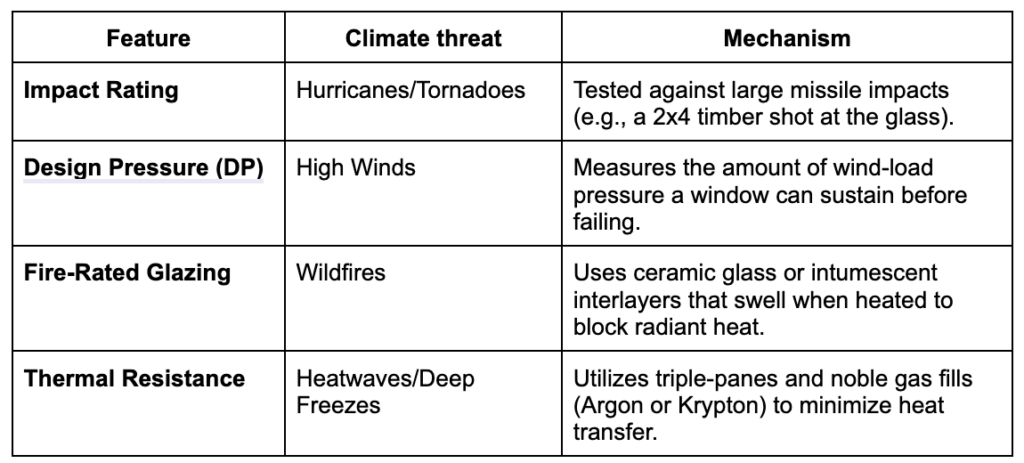
For optimal protection, you need to know the types of climate threats you’re facing. Most experts recommend double- and triple-pane windows in all climates (for energy efficiency), but when you’re preparing for stronger storms, hurricanes, or wildfires, the equation changes.
As you can see in the table below, there are different climate-resilient windows for each climate threat:
Invest in Your Peace of Mind
Climate-resilient windows do require a greater initial investment, but if you live in an area at risk of stronger storms, heat waves, or other adverse weather events, it can be worth the financial effort.