


What’s driving the push for faster home renovations in 2026?
Sep 15, 2026Chris Garner
The global home renovation market was valued at $2.05 trillion in 2025, reflecting the scale of an industry that sits at the intersection of real estate, construction, and consumer spending. For homeowners and real estate investors alike, renovations can increase property values while making homes more comfortable, efficient, and functional, reports Reece Windows & Doors.
But creating that value is almost never a straightforward, stress-free process.
This is why there’s a push for a faster, more predictable approach to renovation. Homeowners want projects completed with less disruption, while contractors are under increasing pressure to improve efficiency, shorten timelines, and deliver on their estimates. Contractors who can increase their speed of service without sacrificing quality will find themselves in a better position to increase their business prospects.
Why Homeowners Demand Faster Timelines
Whether it’s a new kitchen, a bathroom remodel, or a full-home renovation, projects routinely exceed their original timelines and budgets.
Once work begins, residents have to navigate the disruption of living through construction. Contractors, meanwhile, feel pressured to produce quicker results.
How Minimizing Disruption Saves Time and Money
During home renovations, workers often have to be inside a residence, which can be disruptive. Between the materials needed to protect the home, dust particles, materials being stored, and noise, there can be severe disruptions to the living space while work is ongoing.
Residents understand that this is part of a renovation project, but they also want the process to be as quick as possible. It’s important for contractors to properly evaluate a project so that they can give the most accurate timeline possible. It’s also important to ensure that all materials are in hand before work begins so that timelines aren’t disrupted by logistical failures.
Why Bundling Multiple Projects Reduces Total Costs
For homeowners facing multiple renovation needs, tackling everything in a single, coordinated project can be more efficient than working on one issue at a time. If a renovation already causes noise, dust, and contractors to be in the house, it makes sense to address several projects at once.
A kitchen remodel, for example, can be combined with a bathroom renovation and plumbing upgrades. The same approach can extend to other parts of the home, such as making window and door replacements part of a larger project that also includes ventilation and insulation upgrades.
Bundling several projects into one carefully coordinated renovation can minimize disruption and reduce the need for repeated work. There may also be a financial advantage for homeowners who choose to work with a single contractor.
For contractors, this helps increase the scope of a project so they receive more money up front, but it also means that supplies can be ordered in bulk and shipped once, saving on delivery fees. It also means that they can schedule workers once instead of over multiple projects.
How Faster Renovations Lower Hidden Expenses
For property investors, faster renovations can translate directly into lower costs. Every day a project runs past its original deadline can add expenses, from temporary housing and storage to lost rental income.
Shortening the renovation timeline by even a few weeks can bring a property back onto the rental market sooner, helping investors recoup lost income and improve the project’s overall economics.
For homeowners, a faster renovation can mean fewer nights in a hotel, less time paying for off-site storage, and less disruption to everyday life.
Delivering Faster Home Renovations
Faster home renovations shouldn’t mean low quality or cutting corners. Efficiency should come from good planning, solid decision-making, and working with experts who value their clients’ time and convenience.
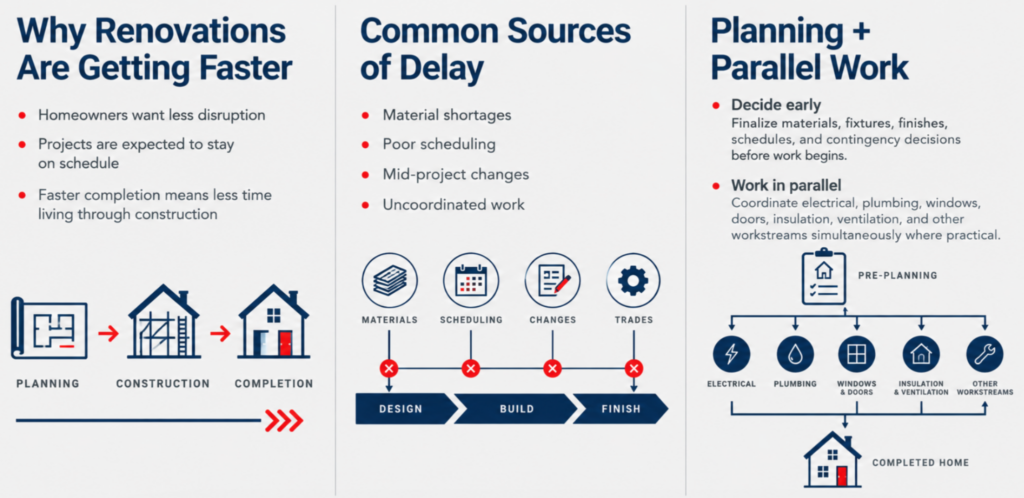
Most renovation delays stem from supply issues, poor scheduling, and mid-project changes. By removing these hurdles from the start, contractors can maintain high standards and keep timelines tight.
There are two strategies that contractors also employ to make fast turnaround possible:
- Pre-project decision-making
- Parallel workflows
Why Pre-Project Decisions Prevent Delays
The first strategy requires the major decisions to be made before construction begins. Materials, fixtures, finishes, work schedules, and other project details are finalized in advance, with the necessary equipment, supplies, and resources ordered and ready before the project begins.
The contractor and homeowner also agree upfront to avoid mid-project changes, while any surprises (inevitable in most renovations) are addressed within the framework of the original schedule. Communication is essential; it’s important for contractors to let their clients know what could go wrong so that there’s a plan before work begins. For example, if mold is found, does the homeowner give the contractor permission to undertake mold remediation immediately? Making these decisions before work begins can save both parties time.
Parallel Workflows
The parallel workflow strategy draws on the principles of multi-project management and focuses on running multiple workstreams in parallel.
One crew, for example, can handle the electrical work while another takes care of plumbing. This approach can be particularly effective for projects that combine several renovations, allowing different teams to work simultaneously rather than waiting for one phase to finish before the next begins.
Home owners want renovations with shorter timelines, less disruption, and high quality. While it may seem like an operational challenge, contractors have risen to the challenge and created systems and workflows that meet demand. Renovation businesses can improve customer satisfaction and increase their revenue with the right strategies.