


The psychology of a stress-free home renovation
Jul 15, 2026Chris Garner
Home improvement spending hit record highs in Q1 2026, topping $524 billion, according to the Joint Center for Housing Studies of Harvard University. That’s a lot of money in the ground. Most homeowners who spend that much on renovations are stressed about it. They’re watching budgets tighten, dealing with contractors and living in half-finished homes with dust everywhere and no kitchen for three months.
According to Reece Windows & Doors, a window and door replacement company, the psychological toll is real—both financial and physical. This can look like missing the peace of their own space, the disruption to routines and the family tension that comes with a construction zone where the living room used to be. But homeowners don’t have to white-knuckle through it. Research shows there are concrete steps that separate the projects people survive from the ones they regret.
The Importance of Environment
The intuitive concept of having access to clean and tidy domestic spaces as a way of remaining calm and content at home is supported by extensive research, summarized in a paper published in the International Journal of Environmental Research and Public Health, which concludes that poor physical housing conditions and structural disruption directly correlate with feelings of frustration and irritability, while also leaving people mentally fatigued.
Everything from unusual smells and loud noises to thermal discomfort exacerbates stress. With the proportion of time spent indoors rising from 60% to 85% over the past half-decade, in part due to lingering habit changes brought about by the COVID-19 pandemic, renovation work thus poses a problem from a home-environment perspective.
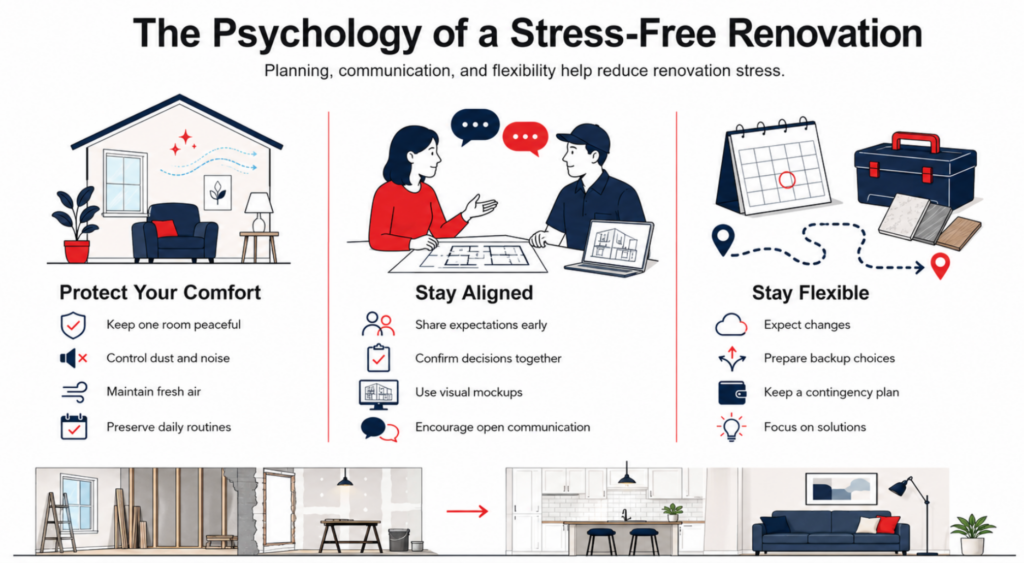
Proper planning helps address these potential drawbacks of renovation by giving homeowners the chance to plot out where and how they’ll live during the work. How this plays out depends on the scope of the work, the budget, and the size of the property. For instance, designating certain rooms as sacrosanct, keeping them free from the clutter and dirt that can arise even in the best-managed remodeling project, means there’s a place where the temperature and air quality are adequate and a sense of normality still reigns.
The Impact of Communication
A stress-free renovation is as much a function of how homeowners interact with the professionals carrying out the work as it is their management of domestic arrangements. Construction workers and contractors across various disciplines are known to suffer from work-related stress, while also operating in an industry where help-seeking behaviors suffer from a degree of stigma, specifically in relation to mental health challenges.
This is explored in detail in a paper given at the International Conference on Transportation and Development 2024 and published by the American Society of Civil Engineers (ASCE). Common stressors include the demanding nature of the work and the discomfort of the work environment.
Similarly, a report on the advantages of prefabricated construction singles out other mental health stressors. Researchers found that job intensity, complexity, and uncertainty in project duration are the main factors that create and exacerbate mental health issues.
The homeowner’s responsibility in reducing stress lies in ensuring that all communication with contractors is carried out with complete transparency and that there’s unity in planning and decision-making throughout the project. Again, thorough planning makes a difference here, and when the project is stress-free for construction professionals, the likelihood of site friction arising or errors occurring is much lower.
Achieving this clarity and consistency in communication is easier thanks to the technology available today. Using AI image generators to create detailed mock-ups helps align homeowner and contractor expectations far more effectively than verbal descriptions or sketches.
Preparing for Delays Strengthens Renovation Resilience
The final psychological aspect in making renovations as stress-free as possible is acceptance. Homeowners must be prepared for delays and disruption, as these are incredibly common, even if homeowners have perfectly formed plans in place and stay on top of client-contractor communication.
Being prepared for potential supply chain disruptions and having backup options in place if it becomes apparent that certain materials won’t be available in time for a project is a good starting point. Having a budgetary contingency to account for spending overruns is also a must. Planning for the best outcome, anticipating what could go wrong, and keeping a cool head when it does will serve households well, whatever a renovation project throws at them.